
Siding Painting Cost and Process in 2026
House Painting Specialists breaks down siding painting cost so homeowners budget accurately before hiring a contractor. Professional siding painting costs $1.50 to $5 per square foot in 2026, putting a standard 1,500 sq ft siding exterior at $2,250 to $7,500. The final price depends on siding material, surface condition, number of coats, and paint type.
Siding material determines the entire pricing structure. Vinyl siding, wood siding, fiber cement (Hardie board), and aluminum siding each require different prep methods, primer types, and paint formulations. A paint system designed for wood siding fails on vinyl because vinyl expands and contracts at twice the rate of wood during temperature cycles.
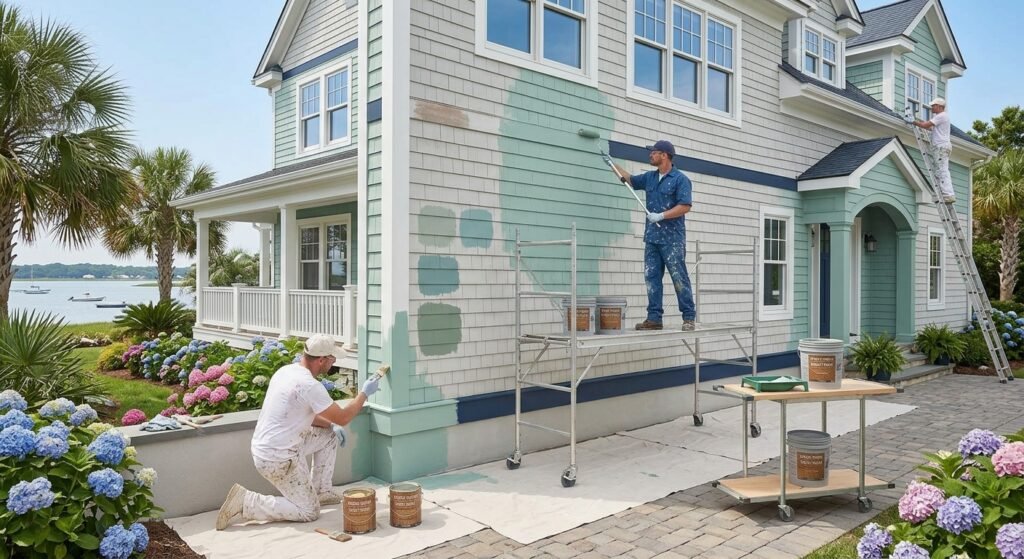
Siding Painting Cost by Material Type
Siding painting cost varies by material because each siding type absorbs paint differently, requires different prep work, and uses different primer and paint chemistry. Wood siding requires the most prep labor. Vinyl siding requires the least prep but demands paint formulated to flex with thermal expansion.
| Siding Material | Cost Per Sq Ft | 1,500 Sq Ft Home | Repaint Cycle |
|---|---|---|---|
| Vinyl siding | $1.50 to $3.00 | $2,250 to $4,500 | 7 to 10 years |
| Wood clapboard / lap siding | $2.50 to $5.00 | $3,750 to $7,500 | 5 to 7 years |
| Fiber cement (Hardie board) | $2.00 to $4.00 | $3,000 to $6,000 | 10 to 15 years |
| Aluminum siding | $2.00 to $3.50 | $3,000 to $5,250 | 8 to 12 years |
| Cedar shake / shingle | $3.00 to $6.00 | $4,500 to $9,000 | 5 to 7 years |
| T1-11 plywood siding | $2.00 to $4.00 | $3,000 to $6,000 | 5 to 8 years |
These ranges cover power washing, scraping loose paint, spot priming, and 2 coats of exterior-grade paint matched to the siding material. Cedar shake costs more per square foot because the textured surface requires hand-brushing or spray-and-backbrush application that consumes 30% more paint and labor than flat lap siding.
Cost Factors That Change Siding Painting Price
Five variables move siding painting cost above or below the average range. Surface condition and siding material create the largest price swings because both determine prep labor intensity and paint consumption per square foot.
| Cost Factor | Impact on Price | Why It Changes the Rate |
|---|---|---|
| Surface condition (good vs peeling vs bare wood) | +$0.50 to $2.00/sq ft | Peeling siding requires scraping, sanding, and full-surface priming before finish coats |
| Home height (1-story vs 2-story vs 3-story) | +25% to 60% | Ladder repositioning and scaffolding add 3 to 6 hours of access labor per elevation |
| Trim included vs siding only | +$1,000 to $3,500 | Window casings, fascia, soffits, and corner boards priced separately at $1 to $4/linear ft |
| Paint grade (contractor vs premium) | +$0.25 to $1.00/sq ft | Premium acrylic delivers 10 to 15 year durability vs 5 to 7 years for contractor grade |
| Color change (light to dark or reverse) | +$0.50 to $1.00/sq ft | Requires tinted primer coat for full color coverage in 2 finish coats |
Homes with well-maintained siding in good condition (no peeling, no bare substrate, no rot) fall at the low end. Homes with deferred maintenance, 2+ stories, and full trim packages fall at the high end.
Siding Paint Types by Material
Each siding material requires a specific paint formulation. Applying the wrong paint type to a siding material causes adhesion failure, peeling, and premature coating breakdown regardless of surface preparation quality.
| Siding Material | Required Paint Type | Cost Per Gallon | Why This Formula |
|---|---|---|---|
| Vinyl siding | 100% acrylic latex (vinyl-safe, LRV 55+) | $40 to $65 | Must flex with vinyl thermal expansion; dark colors absorb heat and warp vinyl panels |
| Wood clapboard | Exterior acrylic latex or alkyd primer + acrylic top | $35 to $60 | Acrylic breathes and flexes with wood moisture cycling; alkyd primer seals bare wood grain |
| Fiber cement | 100% acrylic latex (masonry-grade) | $35 to $60 | Fiber cement is cementitious; requires alkali-resistant acrylic formulation |
| Aluminum siding | DTM (direct-to-metal) acrylic or alkyd enamel | $40 to $70 | Bonds to oxidized metal surface; self-priming formulas eliminate separate primer step |
| Cedar shake | Solid or semi-transparent stain, or 100% acrylic latex | $35 to $65 | Stain penetrates rough texture; latex sits on surface and requires more prep on weathered cedar |
Vinyl siding requires paint with a Light Reflectance Value (LRV) of 55 or higher. Colors below LRV 55 (dark blues, deep reds, charcoal) absorb enough solar heat to soften vinyl panels and cause permanent warping and buckling. House Painting Specialists confirms LRV on every vinyl siding color selection before application.
When to Paint Siding vs. Replace Siding
Siding painting costs 70% to 85% less than siding replacement. A full siding replacement on a 1,500 sq ft home runs $8,000 to $25,000 depending on material (vinyl $8,000 to $12,000, fiber cement $12,000 to $18,000, wood $15,000 to $25,000). Painting the same home runs $2,250 to $7,500, a fraction of the broader house painting cost a full replacement would represent.
Painting delivers the right return when the siding substrate is structurally sound with no widespread rot, delamination, or insect damage. Scattered damage on 5% to 10% of boards can be repaired with spot replacement before painting at $10 to $30 per board. When damage exceeds 15% to 20% of total siding area, full replacement becomes more cost-effective than repairing and painting because repair labor approaches replacement labor cost.
House Painting Specialists inspects all siding surfaces during every exterior painting estimate and identifies which boards need spot replacement, which areas need intensive prep, and which elevations are in paint-ready condition. This inspection prevents homeowners from paying for a full repaint on siding that needs partial replacement first.
The Siding Painting Process
Professional siding painting follows a 5-step process that takes 3 to 7 days for a standard 1,500 sq ft home, and covers a similar prep sequence to brick painting and stucco painting on masonry homes.
- Power washing – The crew washes siding at 1,500 to 2,500 PSI to remove dirt, mildew, chalking residue, and cobwebs. Vinyl siding requires lower pressure (1,200 to 1,800 PSI) to avoid forcing water behind the panels. The surface dries for 24 to 48 hours.
- Scraping and sanding – Loose and peeling paint is scraped to a firm edge, then sanded smooth with 80 to 120 grit. Wood siding with bare spots receives hand-sanding to open the grain for primer adhesion. This step accounts for 25% to 40% of total labor time on homes with deferred maintenance.
- Spot repair and priming – Rotted or damaged boards are replaced. Bare wood, scraped edges, and patched areas receive alkyd or shellac-based primer. Full-surface priming is applied when the existing coating has failed across more than 30% of the surface area.
- Finish coats – Two coats of exterior paint matched to the siding material are applied by airless sprayer with back-brushing on wood lap siding to work paint into the overlap joints. Each coat dries 4 to 24 hours depending on temperature and humidity.
- Detail work – Trim, window casings, door frames, and soffits receive separate masking and trim-specific paint, coordinated with any exterior trim painting planned for the same visit. Trim work runs concurrently with the second siding coat or immediately after.
Frequently Asked Questions
How much does it cost to paint siding on a house?
Professional siding painting costs $1.50 to $5 per square foot in 2026. A standard 1,500 sq ft home runs $2,250 to $7,500 for power washing, scraping, priming, and 2 coats of exterior paint. Wood siding and cedar shake fall at the higher end due to increased prep labor.
Can you paint vinyl siding?
Vinyl siding accepts paint when the crew uses 100% acrylic latex formulated for vinyl with an LRV (Light Reflectance Value) of 55 or higher. Colors below LRV 55 absorb too much solar heat and cause the vinyl panels to soften, warp, and buckle permanently. Vinyl siding painting costs $1.50 to $3 per square foot and lasts 7 to 10 years with proper paint selection.
How often does painted siding need to be repainted?
Repaint frequency depends on siding material and paint grade. Vinyl siding lasts 7 to 10 years between repaints. Wood siding lasts 5 to 7 years. Fiber cement lasts 10 to 15 years. Cedar shake lasts 5 to 7 years. South-facing and west-facing elevations fade faster due to UV exposure.
Is it cheaper to paint siding or replace siding?
Painting siding costs 70% to 85% less than full siding replacement. A 1,500 sq ft siding repaint runs $2,250 to $7,500 versus $8,000 to $25,000 for replacement. Painting is the right investment when the siding substrate is structurally sound. Replacement is the better investment when rot, delamination, or insect damage affects more than 15% to 20% of total siding area.
What is the best paint for wood siding?
100% acrylic latex is the best exterior paint for wood siding. Acrylic resin breathes with the wood as it absorbs and releases moisture through seasonal humidity changes, preventing the cracking and peeling that rigid oil-based paints develop after 3 to 5 years. Premium 100% acrylic formulas deliver 10 to 15 year durability on properly prepped wood siding.
Get a Free Siding Painting Estimate
Vinyl, wood, fiber cement, and cedar all need a different paint system. Getting the formula wrong costs you a repaint within a year or two.
House Painting Specialists identifies your siding material and condition on site and recommends the right primer and paint before any work starts.