
Stucco Painting Cost and Process in 2026
House Painting Specialists breaks down stucco painting cost so homeowners budget accurately before hiring a contractor. Professional stucco painting costs $3 to $7 per square foot in 2026, putting a standard 1,500 sq ft stucco exterior at $4,500 to $10,500. The final price depends on stucco condition, texture type, number of coats, and whether cracks require patching before the first coat of paint.
Stucco absorbs paint differently than wood siding or brick. The porous cementitious surface draws primer and paint into micro-cavities across the texture, increasing material consumption by 20% to 40% compared to smooth surfaces. A gallon of exterior paint covers 350 to 400 sq ft on smooth siding but only 200 to 300 sq ft on heavy stucco texture.
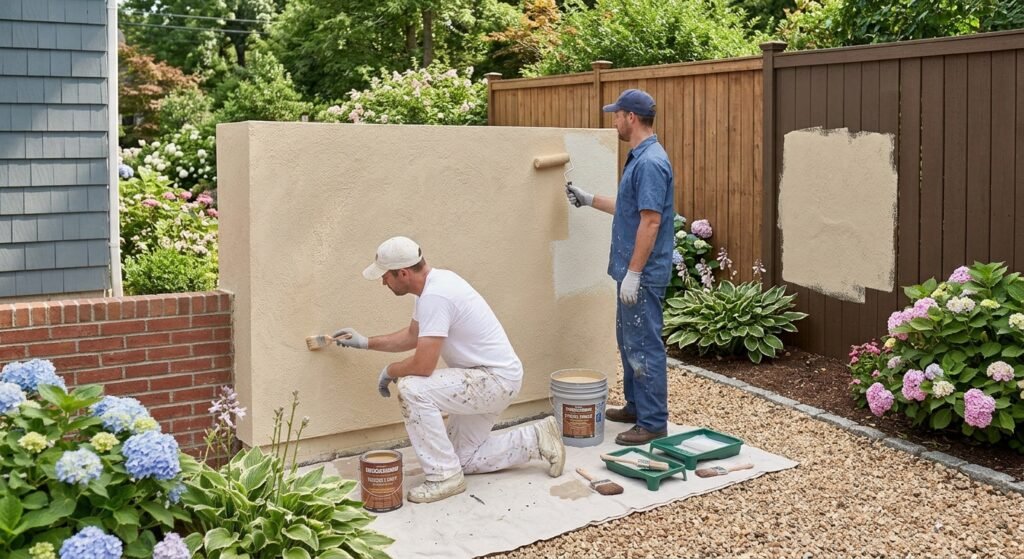
Stucco Painting Cost by Home Size
Stucco painting cost scales with exterior square footage, stucco texture depth, and surface condition. Smooth or sand-finish stucco requires less paint per square foot than heavy dash or lace texture because deeper textures trap more paint in the surface valleys.
| Home Size (Stucco Sq Ft) | Light Texture (Sand/Smooth) | Medium Texture (Lace/Swirl) | Heavy Texture (Dash/Roughcast) |
|---|---|---|---|
| 800 to 1,200 sq ft | $2,400 to $6,000 | $2,800 to $7,200 | $3,200 to $8,400 |
| 1,200 to 1,800 sq ft | $3,600 to $9,000 | $4,200 to $10,800 | $4,800 to $12,600 |
| 1,800 to 2,500 sq ft | $5,400 to $12,500 | $6,300 to $15,000 | $7,200 to $17,500 |
| 2,500 to 3,500 sq ft | $7,500 to $17,500 | $8,750 to $21,000 | $10,000 to $24,500 |
These ranges cover power washing, crack repair (hairline to 1/4 inch), masonry primer, and 2 coats of 100% acrylic exterior paint. Homes with extensive cracking, water damage, or failing previous coatings require additional prep that pushes cost toward the high end.
Cost Factors That Change Stucco Painting Price
Six variables move stucco painting cost above or below the average range. Crack severity and stucco texture create the largest price swings because both increase labor time and material consumption per square foot.
| Cost Factor | Impact on Price | Why It Changes the Rate |
|---|---|---|
| Crack severity (hairline vs structural) | +$0.50 to $3.00/sq ft | Hairline cracks fill with elastomeric caulk. Cracks wider than 1/4 inch require stucco patching compound and texture matching before painting |
| Stucco texture depth | +15% to 30% material cost | Heavy dash texture consumes 30% to 40% more paint per square foot than smooth finish due to surface area in texture valleys |
| Home height (1-story vs 2-story vs 3-story) | +25% to 60% | Scaffolding setup on multi-story stucco adds 3 to 6 hours of access labor per elevation face |
| Previous coating condition | +$1.00 to $3.00/sq ft | Peeling or chalking previous paint requires scraping, wire brushing, and alkali-resistant primer before recoating |
| Elastomeric vs standard paint | +$0.75 to $2.00/sq ft | Elastomeric coatings cost more per gallon but bridge hairline cracks up to 1/16 inch and flex with thermal movement |
| Color change (light to dark or reverse) | +$0.50 to $1.00/sq ft | Requires tinted primer coat to prevent bleed-through and achieve full color coverage in 2 finish coats |
Stucco Paint Types and Performance
Stucco requires paint formulated for cementitious, alkaline surfaces. Standard interior-exterior latex applied to stucco fails within 2 to 3 years because the alkaline pH of the stucco (pH 12 to 13 when new) breaks down paint resins not designed for masonry. Three exterior paint categories cover the full performance range for stucco surfaces.
| Paint Type | Cost Per Gallon | Coverage on Stucco | Lifespan | Best For |
|---|---|---|---|---|
| 100% acrylic latex (flat or satin) | $35 to $60 | 200 to 300 sq ft/gal | 5 to 8 years | Standard repaints on stucco in good condition with no active cracking |
| Elastomeric coating | $50 to $90 | 100 to 200 sq ft/gal | 8 to 12 years | Stucco with hairline cracks, thermal movement zones, and high moisture exposure |
| Mineral/silicate paint | $60 to $100 | 150 to 250 sq ft/gal | 15 to 20 years | Historic stucco, lime-based stucco, vapor permeability required |
100% acrylic latex is the standard choice for stucco repaints. Elastomeric coatings apply at 10 to 15 mils dry film thickness versus 3 to 5 mils for standard acrylic, bridging hairline cracks up to 1/16 inch. Mineral paint bonds chemically with the calcium in stucco and mortar and is required on historic or lime-based stucco where vapor permeability must be preserved.
Stucco Crack Repair Before Painting
Stucco cracks fall into three categories. Each category requires different repair methods and affects total painting cost differently.
| Crack Type | Width | Repair Method | Cost Impact | Painting Timeline |
|---|---|---|---|---|
| Hairline cracks | Under 1/16 inch | Elastomeric caulk or elastomeric paint bridges the crack without separate repair | $0 to $0.50/sq ft | Paint directly over with elastomeric coating |
| Settlement cracks | 1/16 to 1/4 inch | Fill with polyurethane caulk, smooth flush, then prime and paint | +$0.50 to $1.50/sq ft | Caulk cures 24 to 48 hours before painting |
| Structural cracks | Over 1/4 inch | Cut out damaged stucco, apply bonding agent, patch with stucco compound, texture-match, cure 7 to 14 days | +$2.00 to $5.00/sq ft | Patch cures 7 to 14 days, then prime and paint |
Structural cracks wider than 1/4 inch indicate foundation movement, framing settlement, or water damage behind the stucco. House Painting Specialists recommends the homeowner consult a structural engineer before painting over cracks that signal ongoing movement.
The Stucco Painting Process
Professional exterior painting on stucco follows a 5-step process that takes 3 to 7 days for a standard 1,500 sq ft home, and stucco is one of several surfaces House Painting Specialists covers alongside brick painting as part of the broader house painting cost for a full exterior project.
- Power washing – The crew washes the stucco at 1,500 to 2,500 PSI to remove dirt, mildew, chalking residue, and loose particles. Stucco requires lower pressure than brick (2,000 to 3,000 PSI) because high pressure damages the textured finish and opens the surface to water infiltration. The surface dries for 48 to 72 hours.
- Crack repair and patching – Hairline cracks receive elastomeric caulk. Settlement cracks receive polyurethane caulk smoothed flush with the surrounding texture. Structural cracks receive full stucco patching with texture matching. Patch repairs cure 7 to 14 days depending on thickness and humidity.
- Masonry primer – An alkali-resistant masonry primer seals the porous stucco surface, blocks efflorescence and tannin bleed, and provides a uniform base for the finish coat. Primer penetrates deeper on stucco than on smooth surfaces, consuming 1 gallon per 200 to 300 sq ft versus 350 to 400 sq ft on wood siding.
- Finish coats – Two coats of 100% acrylic latex, elastomeric, or mineral paint are applied by airless sprayer with back-rolling to push paint into texture valleys. Back-rolling is essential on textured stucco because spray alone leaves dry spots in the recesses of heavy dash and lace patterns. Each coat dries 24 hours minimum.
- Trim and detail work – Window casings, door frames, fascia, and soffits adjacent to the stucco receive separate masking and trim-specific paint, coordinated with any exterior trim painting planned for the same visit. Trim work runs concurrently with the second stucco coat or immediately after.
Frequently Asked Questions
How much does it cost to paint stucco exterior?
Professional stucco painting costs $3 to $7 per square foot in 2026. A standard 1,500 sq ft stucco home runs $4,500 to $10,500 for power washing, crack repair, primer, and 2 coats of 100% acrylic exterior paint. Heavy-texture stucco and homes requiring elastomeric coating fall at the higher end.
What is the best paint for stucco?
100% acrylic latex in flat or satin finish is the standard choice for stucco repaints. Elastomeric coating is recommended for stucco with hairline cracks or in climates with wide temperature swings. Mineral paint (potassium silicate) is required for historic or lime-based stucco where vapor permeability must be maintained.
How often does stucco need to be repainted?
Stucco requires repainting every 5 to 8 years with standard 100% acrylic latex. Elastomeric coatings extend the cycle to 8 to 12 years. Mineral paint lasts 15 to 20 years. South-facing and west-facing elevations fade and chalk faster due to UV exposure and require repainting at the shorter end of each range.
Should I use elastomeric paint on stucco?
Elastomeric paint is the right choice for stucco with hairline cracks, stucco in desert or mountain climates with 30+ degree daily temperature swings, and stucco on homes older than 15 years where settlement cracking is common. It costs $0.75 to $2.00 more per square foot than standard acrylic but eliminates the need for separate crack repair on hairline fractures.
Can you paint over old stucco paint?
Repainting over existing stucco paint is standard practice when the current coating is intact with no peeling, chalking, or blistering. When the existing paint is peeling or failing across large areas, the crew scrapes and wire-brushes loose paint, applies full-surface masonry primer, and recoats. Complete paint removal from stucco is rarely necessary.
Get a Free Stucco Painting Estimate
Stucco texture, cracking, and coating history all change the right prep and paint approach. A phone estimate cannot account for any of it.
House Painting Specialists inspects crack severity, texture depth, and previous coatings on site before recommending acrylic, elastomeric, or mineral paint.